
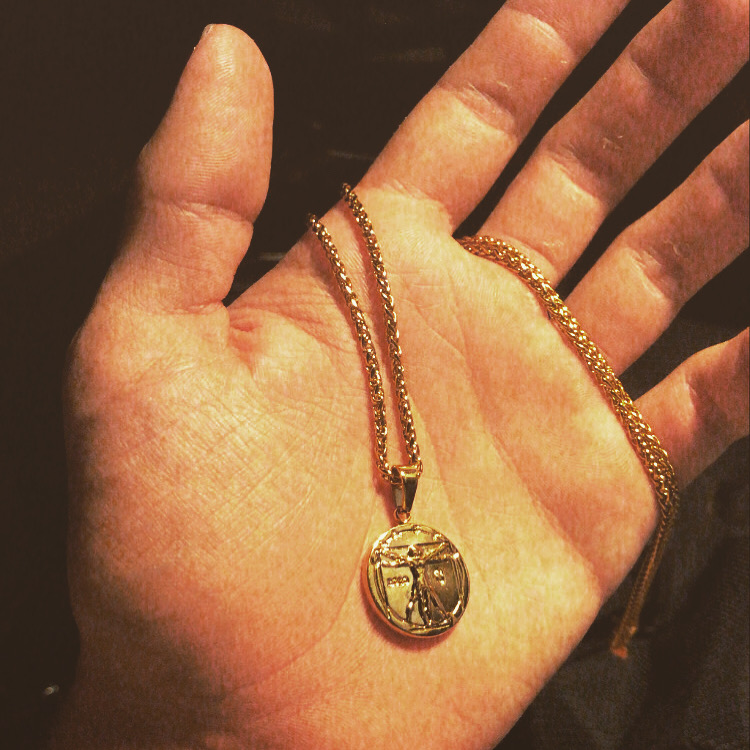
encapsulated by a box, he traverses the globe
fully nude, wears dignity as a robe
articulating art and science, lips sealed closed
the Vitruvian Man does not think: but it seems that he knows.
Like a Hindu deity, sketched excess appendages reach out from the Vitruvian man’s torso. Additional arms and legs stretch to the extremities of his box of ink. Even his long, flowing curly hair seems to spiral outward in the pursuit of freedom. And if that wasn’t symbolic enough, his entire body eschews the restraints of clothing.
According to Encyclopædia Britannica online, “Leonardo envisaged the great picture chart of the human body he had produced through his anatomical drawings and Vitruvian Man as a cosmografia del minor mondo (cosmography of the microcosm). He believed the workings of the human body to be an analogy for the workings of the universe.”
In this drawing, we see encapsulated in ink Da Vinci’s conception of the ideal male form.
But is there truly an ideal human form?
Within the sport of track and field, athletes compete with each other in a variety of events. In each event, some body types perform certain physical feats better than others. High jumpers jump higher, and sprinters sprint faster. Each athlete competes in a realm in which they possess a comparative advantage.
Beyond sports, individual persons possess a variety of unique strengths and weaknesses. Where one falls short, another excels. Where one succeeds, another doesn’t match up. Yet the observation of these natural differences should not lead to hopelessness or apathy: all humans have been endowed with an innate capacity for love and relationship, and with the potential to creatively improve the microcosmos they inhabit.
We can stretch our own hearts and minds, increasing our understanding of the world around us and the people that live within it. Using our unique abilities, we can climb to new heights of creativity and accomplishment.
Every creative act is performed within constraints: the novelist needs their pages, the actor their stage, and the singer their song. But paradoxically, this binding force unlocks the door to limitless possibilities. Like a kite fastened to a kite string, the very thing that seemingly restrains us actually enables us to soar to unimagined heights. As Marcus Aurelius wrote in his Meditations, “The mind adapts and converts to its own purposes the obstacle to our acting. The impediment to action advances action. What stands in the way becomes the way.”
Though we are finitely limited by the scope of our individuality, we find complementary strengths in the company of others, allowing us to achieve what we could not do on our own.
Though true perfection is unattainable,
“The ideal man bears the accidents of life with dignity and grace,
making the best of circumstances.”
–Aristotle
 kindagenau